
Providing you with ESG evidence for your investors and funders
Mental Health Risk Intelligence provides organisations with the infrastructure for identifying, managing and evidencing workforce psychosocial risk — converting mental health from a wellbeing initiative into a measurable component of ESG risk management.
The Mental Health Risk Intelligence system provides you with:
E - Environmental Evidence
-
supports workforce resilience during climate/operational transition
-
contributes indirectly to just-transition considerations
S - Social Evidence
-
healthier workforce
-
psychological safety
-
reduced psychosocial risk
-
improved employee experience
-
better workforce sustainability
G - Governance Evidence
-
risk identification
-
board visibility
-
accountability
-
documented controls
-
evidence-based decision-making
-
auditability
Bridging the gap between “we have a people policy” and “we have evidence that we understand and manage people-related risk.”
Evidencing the Social strand
Your staff mental health provision is primarily part of the Social aspect of ESG. The Mental Health Risk Intelligence system helps you to map actions against your ESG reporting.
It can help an organisation demonstrate that it is actively managing:
-
employee health, safety and wellbeing;
-
psychosocial risks such as excessive workload, poor management, conflict and organisational change;
-
psychological safety;
-
employee support and engagement;
-
sickness absence and potentially turnover/productivity risks;
-
the effectiveness of interventions rather than simply whether wellbeing programmes exist.
MHRI provides the measurement and monitoring layer underneath a company's Social ESG strategy.
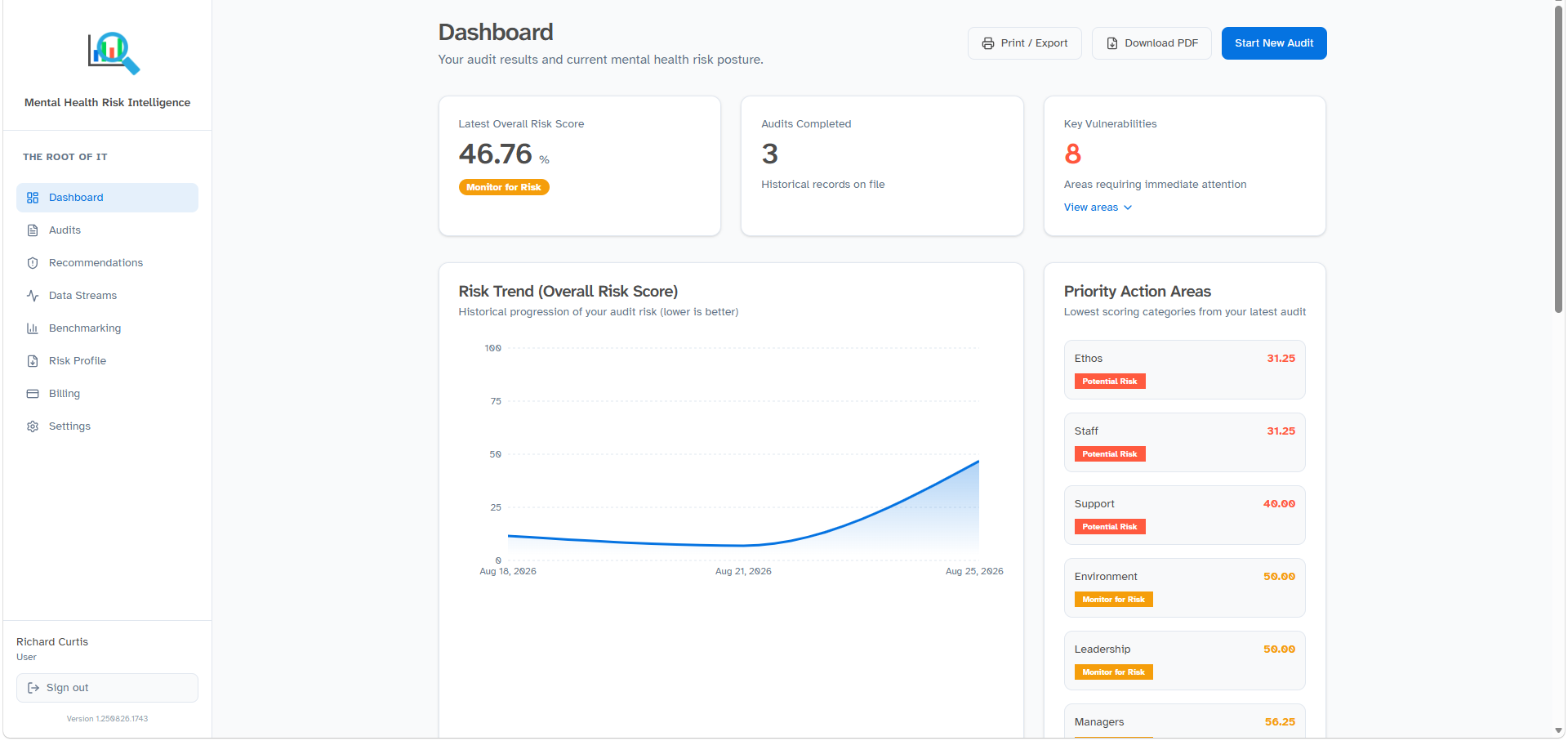
MHRI allows you to say “We systematically assess mental-health risk, identify the areas of greatest exposure, implement interventions, and monitor whether risk is reducing.”
MHRI allows you to say “We have made mental health less of an HR initiative and more of an enterprise risk-management issue.”
Evidencing the Governance strand
Governance isn't just about boards, corruption and compliance. It is also about whether an organisation has appropriate systems for identifying, managing, monitoring and reporting material risks.
The Mental Health Risk Intelligence dashboard approach gives the board or senior leadership the full governance cycle:
Risk identification → risk assessment → intervention → monitoring → evidence of impact
MHRI supports governance by giving organisations:
-
a repeatable risk-assessment methodology;
-
management information for senior leadership;
-
evidence of risk-control activity;
-
trend data;
-
evidence that interventions have been reviewed;
-
an audit trail around workforce mental-health risk;
-
a mechanism for escalating significant risks.
Evidencing the Environmental strand
Mental-health risk intelligence is not primarily an environmental ESG technology.
But there is a secondary connection.
Major environmental or climate-related changes can create workforce psychosocial risks — for example:
-
extreme weather;
-
climate-related disruption;
-
major organisational transition;
-
restructuring associated with decarbonisation;
-
increased workload during transformation;
-
uncertainty about jobs and skills.
The system is therefore part of workforce resilience.
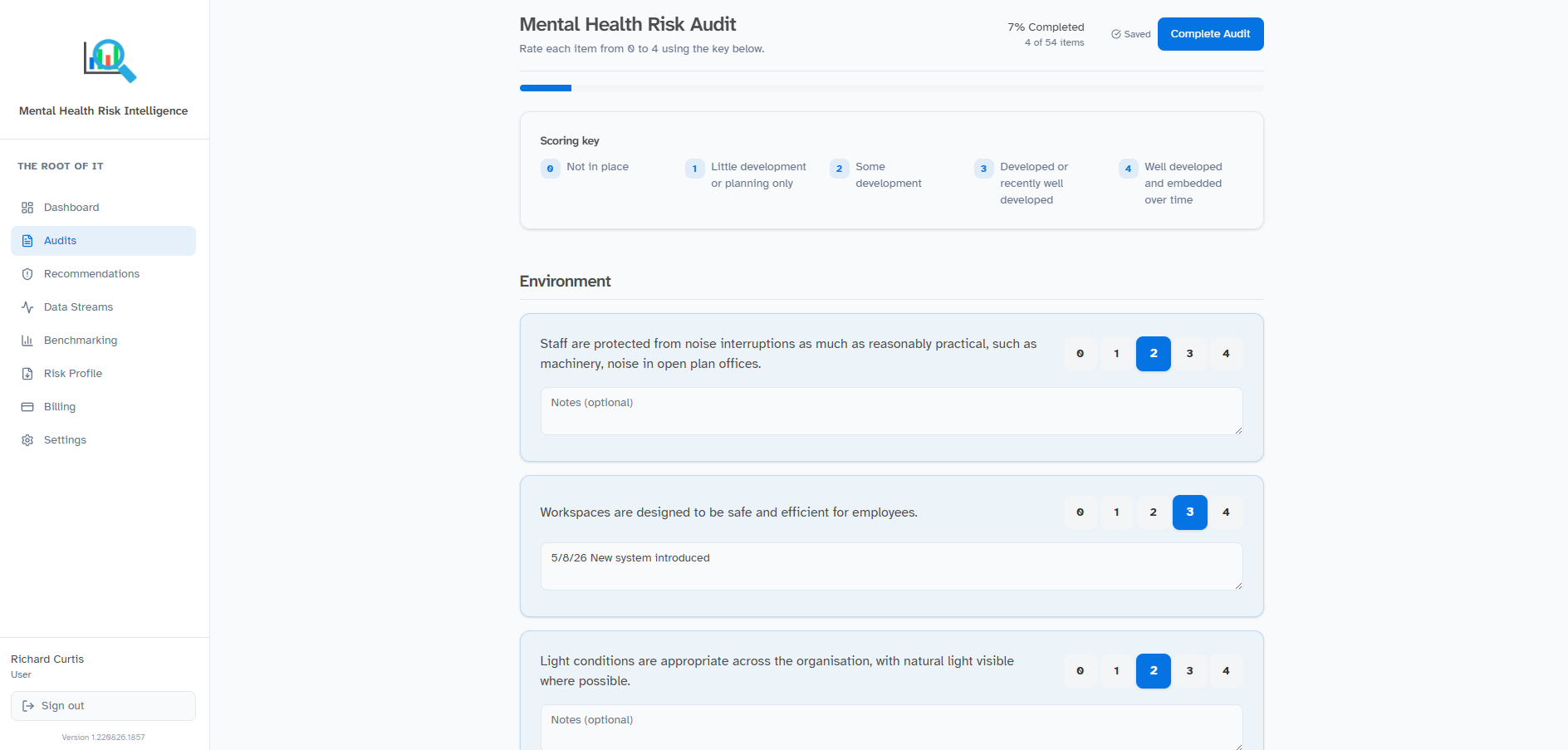
MHRI allows you to say “We reassess psychosocial risk in response to environmental changes."
Mental Health Risk Intelligence provides organisations with infrastructure for identifying, managing and evidencing workforce psychosocial risk — converting mental health from a wellbeing initiative into a measurable component of ESG risk management.
The Mental Health Risk Intelligence system provides evidence for a company's European Sustainability Reporting Standards.
|
MHRI capability |
ESRS S1 connection |
Potential evidence/data |
|
Mental-health risk assessment |
Material workforce impacts, risks & opportunities |
Workforce mental-health risk profile |
|
Psychosocial-risk identification |
Health & safety / working conditions |
Risk prevalence by organisational area |
|
Risk segmentation |
Materiality assessment |
High/medium/low-risk populations |
|
Management dashboard |
S1 governance/management |
Board and executive reporting |
|
Intervention planning |
S1-4 Actions |
Action plans against identified risks |
|
Intervention monitoring |
S1-4 effectiveness |
Before/after risk measures |
|
Mental-health trends |
S1 metrics |
Risk trend over time |
|
Workforce participation |
Stakeholder engagement |
Employee input / engagement |
|
Risk targets |
S1 targets |
Reduction/improvement targets |
|
Audit trail |
Governance/assurance |
Evidence of assessment → action → outcome |
|
Health-related outcomes |
S1 health & safety |
Ill-health / absence-related indicators where appropriately collected |
|
Workload/change/management risks |
Working conditions / health & safety |
Psychosocial risk indicators |
Ready to start assessing your Mental Health Risks?
Sign up for the EXTENDED pre-launch before 20th SeptemberNormal annual pricing:
Up to 50 staff: £300 + VAT
51-500 staff: £1,499 + VAT
501+ staff: £3,999 + VAT
Please contact hello@richarddanielcurtis.com for multisite pricing.
Prelaunch Offer EXTENDED
Day(s)
:
Hour(s)
:
Minute(s)
:
Second(s)