
What evidence do you have of the impact of your people strategy?
How are you meeting your duty of care?
Introducing Mental Health Risk Intelligence, the tool that helps you assess and monitor the impact of your people approach.
An evidence-based online tool that ensures that businesses and organisations are helping their people to thrive.
Suitable for:
- CEOs
- C-Suite
- Mental Health Officers
- Wellbeing Leads
- Health and Safety Officers
Aligns with the UK's Policy Liaison Group on Workplace Wellbeing guidance Good Work, Good Health, Good Growth.
Key Benefits
Changing employee mental health from a qualitative “wellbeing” issue into a measurable workforce-risk and governance issue.
- A solution to systemise a complex problem
- Know your mental health gaps
- Gain insight into the biggest mental health risks in your organisation
- Develop an evidence-based psychosocial risk assessment for your organisation
- Track the impact of your changes or interventions
- Benchmark yourself against others in your sector
Be assured you have everything covered, sign up today
Sign up for the EXTENDED pre-launch before 20th SeptemberNormal annual pricing:
Up to 50 staff: £300 + VAT
51-500 staff: £1,499 + VAT
501+ staff: £3,999 + VAT
Please contact hello@richarddanielcurtis.com for multisite pricing.
Prelaunch Offer EXTENDED
Day(s)
:
Hour(s)
:
Minute(s)
:
Second(s)
Mental HEalth Risk Intelligence

Audit
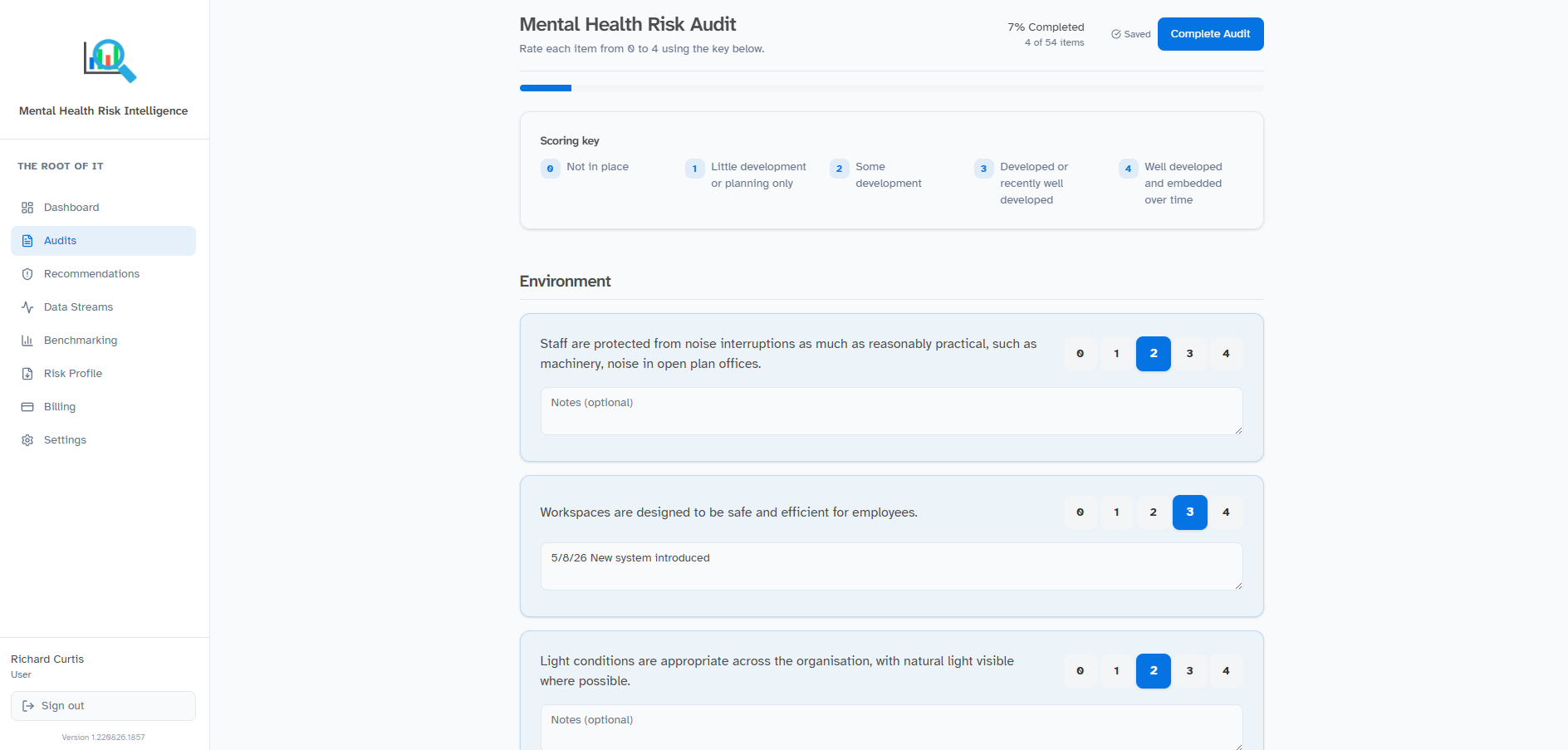
Undertake a comprehensive 54-item audit to undertake your provision, identifying the areas of the business where there are mental health risks. Finally the system produces your customised Mental Health Risk Profile
Environment
- Staff are protect from noise interruptions as much as reasonably practical, such as machinery, noise in open plan offices.
- Workspaces are designed to be safe and efficient for employees.
- Light conditions are appropriate across the organisation, with natural light visible where possible.
- Staff are able to influence or personalise their immediate working environment.
Ethos
- The organisation has a clear purpose and vision.
Staff are emotionally and morally committed to the organisation. - The organisation has clear aims relating to staff wellbeing.
Wellbeing concerns can be raised locally without necessarily going to HR or occupational health. - There is a staff mental health and/or wellbeing strategy in place.
- Activities, such as newsletters or profile raising, demonstrate the organisation's commitment to staff wellbeing.
- The organisation's approach to diversity or inclusion reflects a culture of belonging and safety.
- The organisation is able to demonstrate a commitment to the people within it, such as a charter or Investors in People.
- Staff have economic security, including receiving a living wage.
- Mentoring and coaching is used to develop staff across the organisation.
- The organisation recognises the importance of social relationships and reducing staff isolation.
- There are staff benefit systems in place, such as shares, insurance or memberships.
Health and Safety
- Mental health is viewed as equivalent to physical hazards within the organisation's health and safety.
- Mental health features in the organisation-wide risk assessment.
- Specific hazards applying to only part of the organisation feature in the psychosocial risk assessment, such as night working teams.
- Specific hazards relating to particular roles feature in the psychosocial risk assessment.
- Departments, such as health and safety and HR, work together to learn from instances of workplace mental health difficulties.
- Managers receive training on how to support and undertake risk assessments that they are experiencing workplace-related mental health difficulties.
Leadership
- People wellbeing is a regular item at board level or senior leadership team if no board.
There is a wellbeing or mental health lead who feeds into the organisation at board level. - The mental health or wellbeing lead monitors the changing staff wellbeing needs.
- The mental health or wellbeing lead oversees the organisation's mental health and wellbeing strategy.
- The mental health or wellbeing lead is senior enough, or is sponsored by a senior leader in a position to be able, to implement organisation wide change.
- The outcomes and effectiveness of support systems, such as EAP or apps, are monitored, reported and acted on.
Managers
- There is specific mental health and wellbeing training for managers.
- Managers or team leaders understand how to support the wellbeing of their teams.
- Managers or team leaders know how to signpost staff for mental health support, such as to occupational health, employee assistance programmes, or self-support.
- Managers or team leaders actively support prosocial relationships within teams.
- Managers review deadlines, priorities, allocation and tasks in response to increased pressure.
Staff
- Staff voice or data is used to strategically inform the organisation's mental health or wellbeing strategy.
- Mental heath and wellbeing related training is available for all staff regardless of their situation.
- There is regular CPD and training available for staff for them to develop themselves.
- There are clear career progression pathways for staff across the organisation.
- The experience of staff within the organisation is monitored and fed into the strategy as appropriate.
- The organisation support staff to maintain a work life balance and monitors excessive overtime.
- Staff understand the key mental health and wellbeing policies and processes.
- Feedback from people leaving the organisation is monitored and fed into the strategy as appropriate.
Support
- There is a range of support available for staff, such as self-help, employee assistance programmes, software or portals.
- Self-help and support information for mental health concerns is freely available for staff without needing to go through a gatekeeper.
- When staff raise concerns about their own wellbeing individual risk assessments can be carried out at a local level.
- Managers can make reasonable adjustments in response to staff raising well-being concerns without judgement, such as workload or time pressures.
- Support isn't just restricted to mental health, support for other wellbeing-related factors such as debt or physical health, are available too.
Systems and Processes
- The key mental health and wellbeing policies, procedures and support form part of the universal staff induction process for the organisation.
- There is a process for supporting staff wellbeing during periods of change.
- Staff wellbeing is embedded in functional policies and processes, such as bullying or capability.
- Staff wellbeing or mental health has a dedicated policy.
- Planning for effective communication forms part of preparation for change.
- There are processes in place to support the identification of staff mental health difficulties at a local level, and to provide nonjudgemental support and signposting.
- There is a celebration or reward system in place for effort or performance.
Job descriptions and processes make responsibilities clear with no ambiguity. - Ambiguity in processes is eliminated or minimised, to avoid vagueness or conflicting responsibilities.

Data
Mental Health Risk Intelligence then supports you in collecting and analysing data from across the organisation.
Select your data streams
Select the data streams that you have access to from the options within the system.
Enter your baseline data
Enter current and historic data for your selected data streams.
Select your monitoring interval
Select whether you will monitor data weekly, monthly or another interval.
Enter Updated Data
Keep the system up to date with your selected data streams.
Review Your Mental Health Risk Dashboard
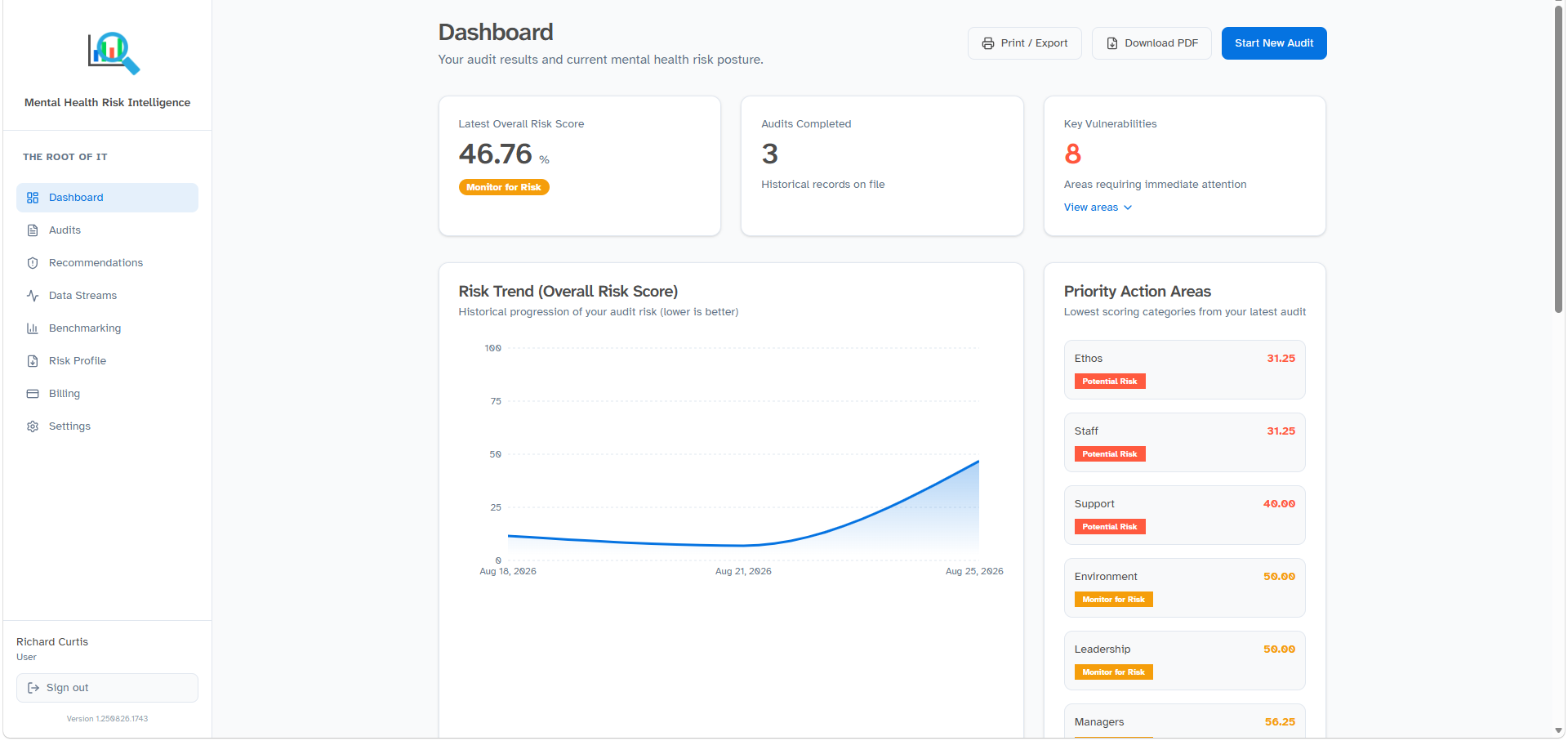
Your Mental Health Risk Dashboard displays the analysis of the data over time.
About Mental Health Risk Intelligence
Mental Health Risk Intelligence
Defined as the collection of data combined with an audit to be able to identify the level of risk across an organisation.
Mental Health Risk Audit
The process of assessing an organisation against evidence-based items.
Mental Health Risk Profile
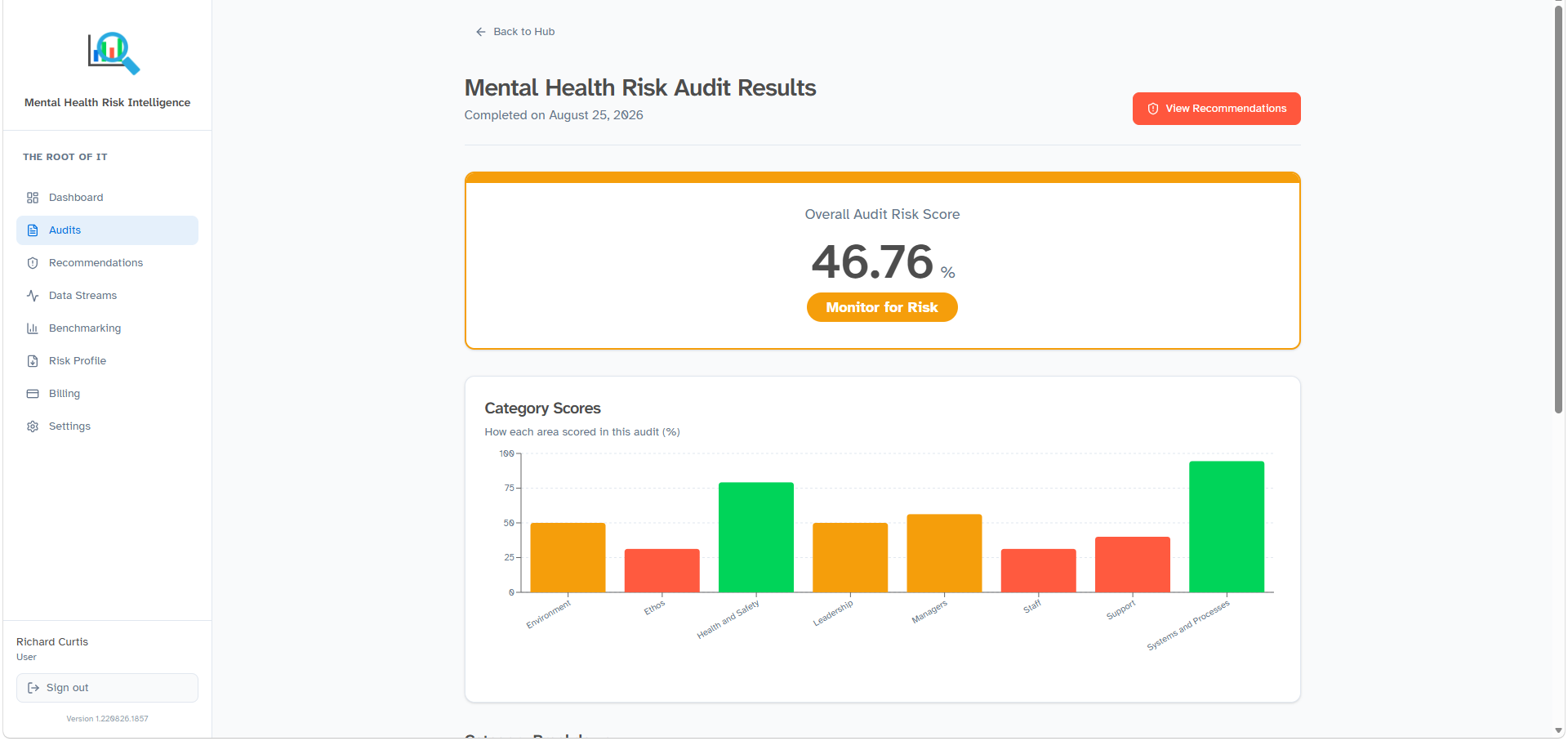
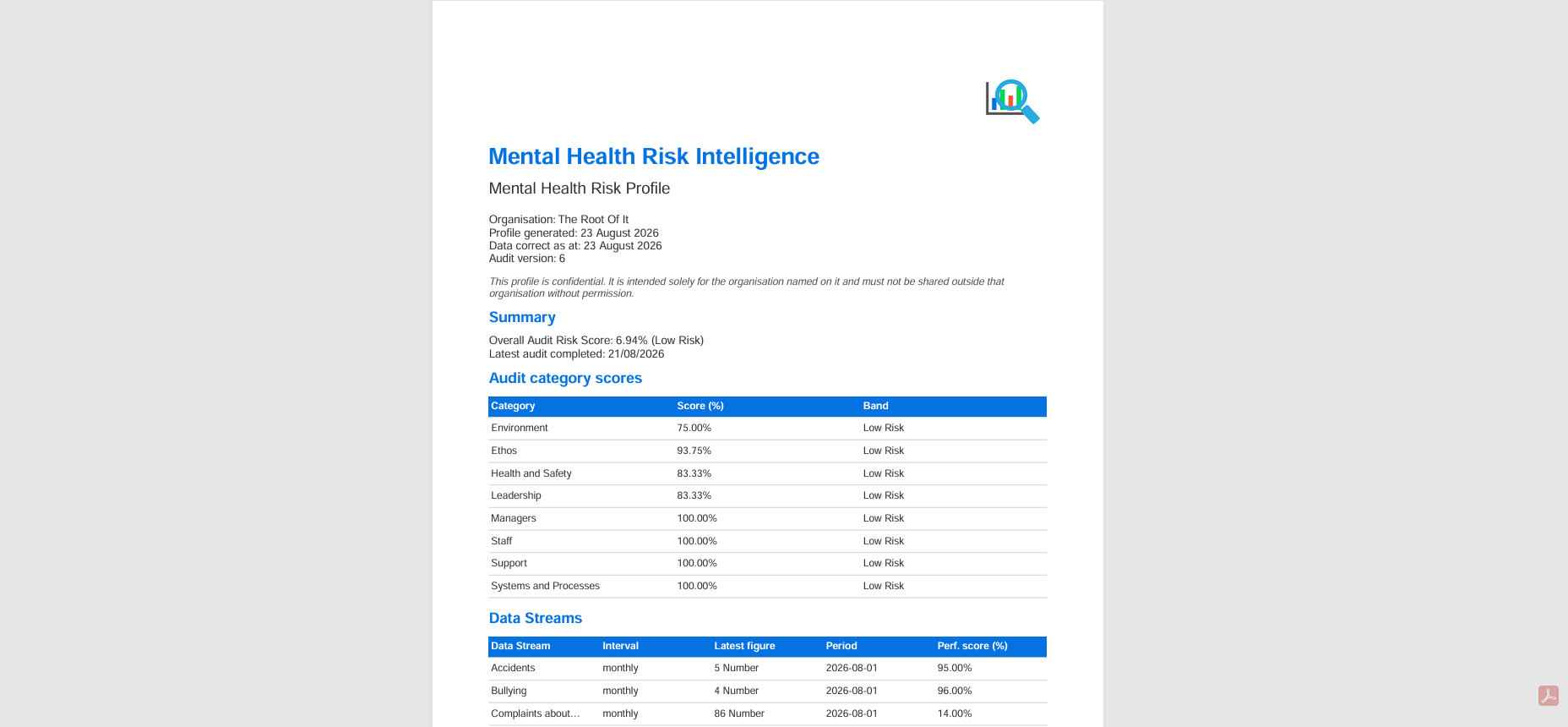
A review of the outcomes of the Mental Health Risk Audit, identifying areas of strength, weakness and potential actions.
Mental Health Risk Dashboard
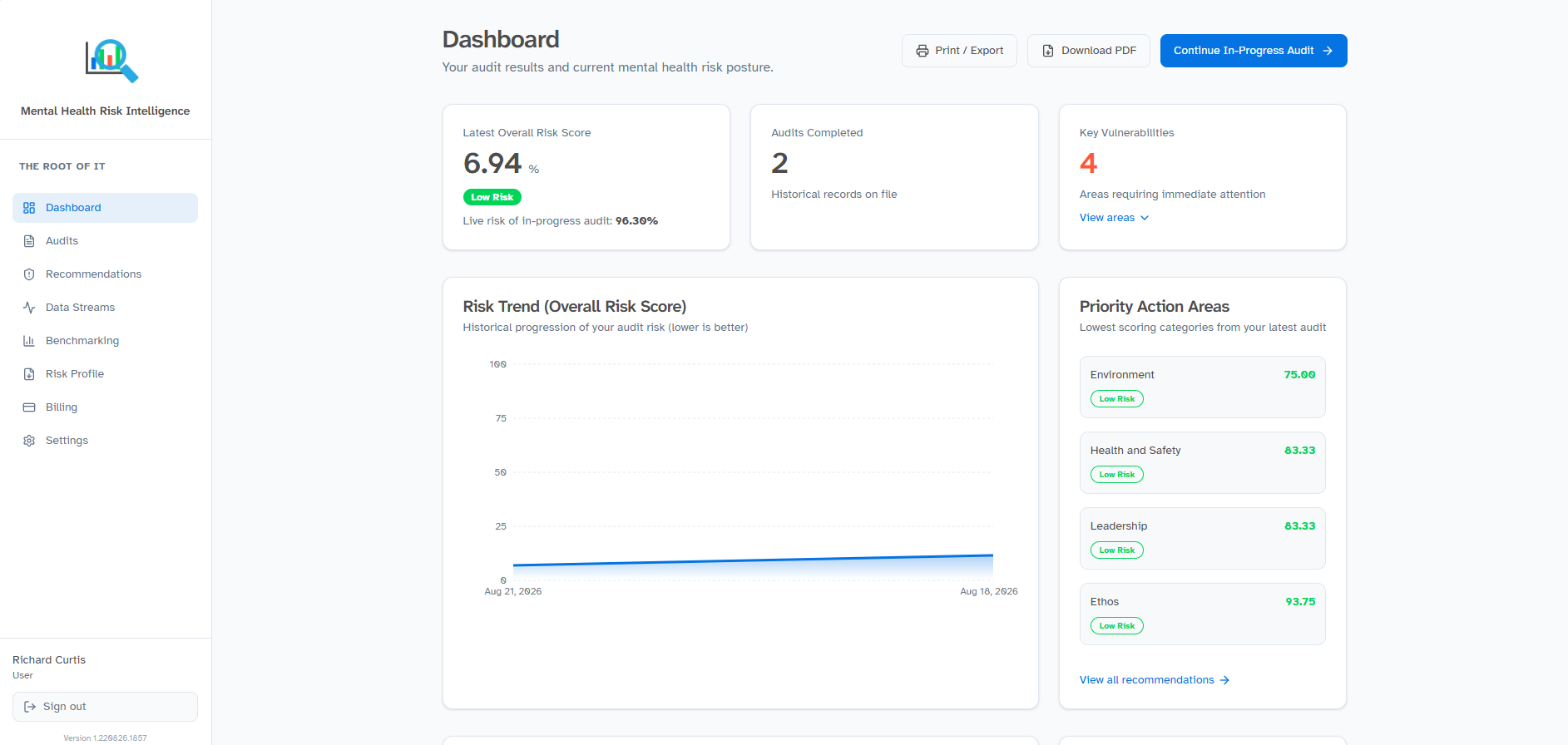
A user-friendly dashboard reporting the data compiled through Mental Health Risk Intelligence.
>>Download the Business Case for Mental Health Risk Intelligence<<
Mental Health Risk Intelligence Guarantee
100% Money-back guarantee = No risk purchaseWe know that you may have been told that your Occupational Health or Employee Assistance Programme provider does this for you.
THEY DON'T.
You may think that you have this organisation-wide understanding covered.
YOU DON'T.
And we guarantee it.
When you purchase access to the Mental Health Risk Intelligence System you are covered by a 100% money back guarantee.
Try the system, take the full audit and enter 2 set of data in the Mental Health Risk Intelligence system, and we GUARANTEE that you will have a better insight into your organisation's mental health risk.
You will have:
- an assessment of organisational risk that covers more areas than your current provider gives you;
- a risk score for staff mental health if you haven't been provided one before;
- recommendations to reduce your risk profile that you don't currently receive;
- a more detailed understanding of your data relating to staff wellbeing.
To claim your money back, you can apply within the first 60 days, provided that you have completed the full audit and entered 2 sets of data. You need to provide a copy of the reports and recommendations that you receive from your existing provider or that you do yourself.
Reporting
The System
Mental Health Risk Intelligence
Mental Health Risk Intelligence describes the act of analysing good practice standards with data streams for an organisation. It provides a clear picture of organisational strengths and areas of pscyhosocial risk.
Audit Reporting
Mental Health Risk Profile
To generate a Mental Health Risk Profile organisations complete an in-depth audit of over 50 items relating to employee wellbeing in the workplace. This evidence-based audit has been compiled from research into factors affecting employee wellbeing. The resulting report highlights areas of good practice and those where risks are present.
Data Monitoring
Mental Health Risk Dashboard
By selecting different data streams, users are able to build up a Mental Health Risk Dashboard, analysing the inputted data to view trends. This can be used to monitor the effectiveness of initiatives, strategies and more!
Ready to start assessing your Mental Health Risks?
Sign up for the pre-launch before 20th SeptemberNormal annual pricing:
Up to 50 staff: £300 + VAT
51-500 staff: £1,499 + VAT
501+ staff: £3,999 + VAT
Please contact hello@richarddanielcurtis.com for multisite pricing.
Prelaunch offer ends in
Day(s)
:
Hour(s)
:
Minute(s)
:
Second(s)
GOT A QUESTION?
Send us a message or arrange a time to meet with us